
A roofing claim can involve more than the cost of repairing a roof. In Escondido, roofer liability insurance costs vary according to a contractor’s services, workforce, claims history, location, and selected coverage limits, so there is no single price for every roofing business. This guide explains roofer liability insurance in Escondido and what can affect a claim or its coverage.
It’s reasonable to want clarity when roofing work leads to property damage, a leak, or an injury. You’ll learn what general and professional liability may cover, how responsibility is assessed, and why umbrella coverage can matter when a claim exceeds a primary policy’s limits.
We’ll also explain what influences insurance costs and what kinds of problems may lead a homeowner to file a claim. The goal is to help you understand the questions roofing insurance can raise, and how careful workmanship and clear responsibility help protect your home.
Key Takeaways
- Roofing insurance costs depend on factors such as the work performed, workforce, claims history, and selected coverage limits.
- Property damage and third-party bodily injury claims may involve different facts and coverage considerations.
- Responsibility for roofing damage is assessed by looking at the work, the agreement, and how the damage occurred.
- Faulty installation claims can surface after a project is complete, so the cause and timing of damage matter.
- Professional and excess liability address distinct risks, including certain workmanship allegations and claims that exceed primary policy limits.
WHAT ARE SOME REASONS MY CLIENT MIGHT DECIDE TO FILE A ROOFERS LIABILITY INSURANCE CLAIM?
In Escondido, a homeowner may file a claim if roofing work causes property damage or bodily injury. Whether general liability coverage applies depends on the cause, timing, and policy terms.
Property Damage and Bodily Injury
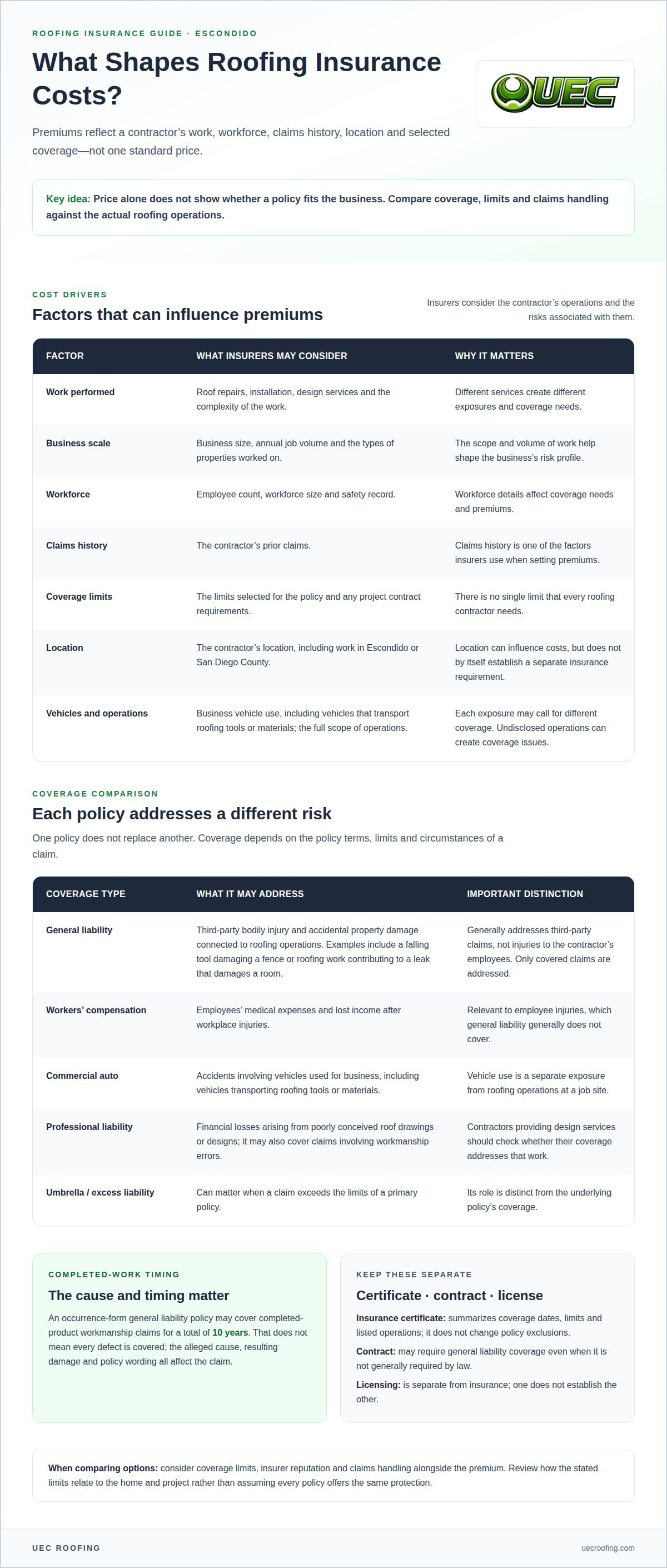
General liability insurance may cover third-party bodily injury and accidental property damage connected to a roofing contractor’s operations. For example, a falling tool could damage a fence, or roofing work could contribute to a leak that damages a room. The policy responds to covered claims, not every issue reported during a project.
There is no single coverage limit that every roofing contractor needs. The appropriate limit depends on the work, potential property exposure, and contract requirements. Homeowners should consider how the stated limits relate to their home and project, rather than assume all general liability policies provide the same protection.
Insurance can also transfer some risk: a covered claim may be handled through the contractor’s policy rather than falling solely on the affected homeowner. General liability generally addresses third-party claims, not injuries to the contractor’s employees. Workers’ compensation is the relevant coverage for workplace injuries to employees.
Workmanship and Completed-Work Claims
A client may file a claim if alleged faulty roofing work later causes property damage. Incorrect material application, for example, could let water in and damage interior finishes. Professional liability may cover claims involving workmanship errors, while general liability may help with third-party property damage and related legal defense, subject to the policy.
Timing and policy form matter after a job ends. An occurrence-form general liability policy may cover completed-product workmanship claims for a total of 10 years. That does not mean every defect is covered; the alleged cause, resulting damage, and policy wording all affect the claim.
Hiring an Uninsured Roofer
If an uninsured roofer’s work damages an Escondido home or injures a third party, there may be no contractor liability policy to respond to the claim. The homeowner could face a more difficult process seeking payment directly from the contractor while repair costs and responsibility remain disputed.
Before work begins, homeowners can review the contractor’s insurance certificate for coverage dates, limits, and listed operations. A certificate does not change policy exclusions. Damage caused by a roof left exposed or improperly covered is often excluded from roofers’ liability policies, making the work method and written terms important.
Factors affecting roofing insurance costs
Roofing insurance premiums vary with location, claims history, workforce, services, and selected limits. For contractors working in Escondido, the work performed and its associated risks shape coverage needs and costs.
Business and Professional Coverage Needs
Contractors’ insurance needs reflect business size, annual job volume, property types, employee count, and roofing services. A company handling complex roof work may face different exposures from one doing smaller repairs. Prior claims and selected limits also influence premiums, so price alone does not show whether coverage suits the business.
Professional liability can protect against financial losses arising from poorly conceived roof drawings or designs. Contractors providing design services should consider whether their coverage addresses that work as well as physical roofing operations.
Insurance Type Differences
General liability addresses third-party bodily injury and property damage claims arising from business operations. Workers’ compensation can cover employees’ medical expenses and lost income after workplace injuries. Commercial auto insurance addresses accidents involving vehicles used for business, including those transporting roofing tools or materials.
These policies address different exposures, and one does not replace another. Employee count, vehicle use, safety record, and work performed can affect the coverage needs and premiums for each type.
California Coverage and License Requirements
General liability insurance may not be required by law, but clients or project contracts may require it. The distinction matters: a contract can set coverage conditions even when there is no general legal requirement.
Insurance and contractor licensing are separate matters. An insurance policy or certificate does not establish a contractor’s licensing status, and licensing information does not describe insurance coverage. Homeowners should consider them separately rather than assume one proves the other.
Local Insurance Rules
A contractor’s location in Escondido or San Diego County can influence roofing insurance costs, but location alone does not establish a separate insurance requirement. Project contracts may set coverage conditions, while policy terms define the scope of protection.
For a local project, distinguish the contractor’s policy, any contract coverage conditions, and licensing information. Each serves a different purpose. A certificate summarizes insurance details, while the policy’s exclusions and limits define its coverage.
Insurers may also consider claims history, workforce size, annual job volume, property types, selected limits, and roofing services. Contractors should disclose the full scope of work, including repairs, installation, and design services. Undisclosed operations can create coverage issues if an incident occurs. Insurers can tailor policies to a business’s operations and risks.
When comparing insurance options, consider coverage limits, insurer reputation, and claims handling alongside the premium. A lower price may not mean the same protection. Review how each policy addresses the contractor’s actual work, employee risks, and vehicles before treating quotes as equivalent.
How is a Roofing Contractor’s Responsibility Determined?
In Escondido, responsibility depends on the work agreement, the damage, and how it occurred. A roof leak after a storm does not, by itself, show that a contractor caused the loss.
Third-Party Injury and Property Claims
Common claims involve a visitor injured by roofing materials or property damaged during work. A falling tool that breaks a window, for example, raises questions about where it fell and who controlled the work area. General liability addresses covered third-party bodily injury and property damage claims arising from business operations.
Responsibility also depends on whether the contractor failed to use reasonable care and skill, causing injury or damage. The contract, work records, photographs, and roof condition can help clarify what happened. An employee injured while roofing presents a different type of claim from an injured homeowner or visitor.
Legal Defense for Property Damage
When a customer alleges faulty roofing work damaged a home, general liability may help cover repair and legal defense costs. The allegation alone does not establish fault or guarantee coverage. For example, an interior stain may require examining the roof, installation details, and other possible sources of water entry.
Policy terms matter alongside the evidence. General liability may cover legal expenses or settlements related to covered accidents, subject to limits and exclusions. The contractor’s agreement and project records can help establish what work was performed and whether the alleged damage is connected to it.
Leaks, Storms, and Responsibility
A leak noticed after a storm can have several possible causes: a workmanship error, pre-existing roof wear, or weather damage. Investigators consider the leak’s location, roof condition, timing, and completed work. A storm after installation is relevant context, but does not by itself prove contractor fault or a weather-only cause.
West Coast atmospheric river or bomb cyclone winds can reach 70 miles per hour. That weather can coincide with roof damage, so timing and physical evidence matter when assessing a claim. Escondido project records, photographs taken before and after work, and an inspection of the affected area can help distinguish storm damage from damage linked to roofing operations.
Contractors are responsible for fulfilling their agreements, completing work within agreed timeframes, and addressing project concerns. Negligence means failing to exercise reasonable care and skill in contractual work, resulting in damage or injury. A review can compare the agreed scope with completed work, safety practices, and observed damage. This helps determine whether a claim concerns contractor conduct, an independent event, or another cause.
Faulty installation and construction defect claims
A construction defect claim examines whether faulty work caused damage, not simply whether a problem appeared after roofing. In Escondido, the alleged installation error, affected materials, and repair records can help distinguish workmanship issues from weather damage or another source.
Workmanship Liability
Professional liability generally applies to claims involving professional services, not the physical installation of roofing materials. Whether a policy covers an allegation related to roofing work depends on its terms, including how it defines covered services and exclusions. A claim still depends on evidence linking the alleged error to the resulting damage. A review can compare the agreed scope, installation details, roof condition, and the location where water entered.
Heavy rain can reveal problems that were not apparent when roofing work was completed. However, the storm’s timing alone does not establish that installation caused a leak. Investigators can examine the affected materials, workmanship, and project records to determine whether an installation error contributed to the damage.
For homeowners, a practical first step is to document the affected area and when the leak appeared. Dated photographs, repair records, and notes about rainfall can preserve relevant details. These records can help clarify whether a claim concerns faulty application, a later accident, or another cause.
Defense Costs and Investigations
A liability claim can involve legal expenses while responsibility is disputed.
The example also shows why investigations consider hidden damage and timing. The nail remained embedded in the pipe for over 3 years before rust caused water damage. For a roofing claim, investigators can compare the reported leak, roof condition, work records, and later repairs to assess whether the alleged workmanship caused the loss.
General liability may help cover legal defense costs for covered third-party property damage claims, while professional liability may apply to certain claims arising from professional services, subject to policy terms. Neither type of coverage necessarily covers roofing installation errors. Repair compensation and defense expenses are separate parts of a claim, so both the cause and policy terms matter.
Accidents and defects require different evidence. A sudden impact during roofing work may leave visible damage, while an installation error can cause a leak later. Keeping project documents and repair findings together gives an investigation a clearer record of what happened and when.
Professional and excess liability insurance
Professional and excess liability address different roofing exposures. In Escondido, the key distinction is whether a claim concerns specialized advice, routine operations, or losses beyond primary policy limits.
Professional Liability for Design and Advice
Professional liability can protect against financial losses arising from poorly conceived roof drawings or designs. For example, a design error might specify a detail that contributes to water intrusion, prompting a claim about the contractor’s professional work. This coverage addresses a different risk from accidental property damage during roofing operations.
Roofing contractors should match coverage to the services they perform. A business that prepares roof drawings or makes design recommendations has a different professional exposure from one doing physical installation alone. Disclosing the full scope of work helps insurers assess that exposure and reduces the risk of a gap between operations and policy terms.
Excess and Umbrella Protection
Umbrella insurance provides additional protection above the limits of a roofing contractor’s primary policies. If a covered claim exceeds a primary policy limit, umbrella coverage may provide another layer, subject to its terms and exclusions. It does not replace the underlying policy or make an uncovered claim covered.
For example, a severe accident could generate third-party property damage and legal expenses that exceed the available primary limit. The practical question is how the umbrella policy coordinates with underlying coverage, including which policies it follows and what exclusions apply. Limits alone do not show the full protection.
Policy Terms, Exclusions, and Other Coverage
Policy wording deserves close attention, especially when a contractor’s coverage is placed through surplus lines. Exclusions can substantially restrict or eliminate coverage, so agents should read them in full. For a roofing business, the review should focus on the work performed, completed operations, design activities, and how umbrella protection interacts with primary policies.
Workers’ compensation insurance serves a separate purpose. It can help cover medical expenses, rehabilitation, and lost wages when an employee is injured on the job. It does not provide excess liability coverage for a homeowner’s property damage claim. Assess each policy against the risk it is intended to address.
A useful review follows three steps: identify the contractor’s operations, match each exposure to its policy, then examine limits and exclusions. For Escondido roofing projects, that means distinguishing design work from installation and checking how excess protection responds above primary coverage. Discuss roofing concerns when roof condition or workmanship needs attention.
UEC Roofing
UEC Roofing helps Escondido homeowners address roof conditions and workmanship concerns that may affect their property. With a brick-and-mortar presence in Lake Elsinore and over 2,000 successful projects in the region, the company serves homeowners across the Inland Empire and Riverside, Orange, and San Diego Counties.
UEC Roofing offers roof replacement, repair, and rejuvenation, with tile, composite shingle, metal, foam, and flat roofing systems. These services can address immediate problems and support ongoing care of your home’s roof.
If you have a roofing concern, contact UEC Roofing to discuss a practical next step.
Protect Your Roof With a Clear Next Step
Understanding roofer liability insurance in Escondido helps homeowners ask clearer questions when roofing work affects their property. The next step is to focus on the roof itself: document concerns, keep project records together, and address visible damage to clarify its cause.
Insurance decisions depend on policy terms and claim evidence. Roofing work can help protect your home when completed with care and attention to lasting performance. If a leak, damaged area, or maintenance concern needs attention, UEC Roofing can help determine the appropriate roofing work for your home.
Contact UEC Roofing to discuss your roofing concern and a practical next step. A well-maintained roof supports the protection of your home and the investment it represents.
Frequently Asked Questions
How much does roofing contractor insurance cost?
There is no single premium for every roofing contractor. Insurers assess the work performed, location, workforce, annual job volume, prior claims, property types, and selected limits. A business handling roof design may also need professional liability, which addresses a different exposure from general liability. To understand a quote, compare the operations and coverage it includes, not just the amount charged.
What Should Roofing Contractors Know About Insurance Availability?
Available policies for roofing businesses may differ in price, terms, and exclusions. Insurers assess roofing risks alongside a contractor’s location, claims history, and operations. Some coverage may be placed through surplus lines, where exclusions can significantly narrow protection. A careful review should identify covered work, exclusions, limits, and claims handling, rather than treating a certificate as the full policy.
Does my policy cover subcontractors?
Do not assume a contractor’s policy automatically covers every subcontractor or their work. Coverage depends on policy wording, exclusions, and how the subcontractor relationship is treated. Insurance agents should review subcontractors’ coverage and certificates because exclusions may limit or eliminate protection. For a roofing project, relevant details include who performed the work, what operations were involved, and whether the resulting claim falls within the applicable policy.
But are roofers responsible for leaks?
A roofer is not automatically responsible whenever a leak appears after roofing work. The cause matters: an installation error, existing roof condition, or weather event can lead to different conclusions. For example, a leak near a repaired area may prompt a review of the work scope and repair records. Responsibility depends on whether the contractor’s work failed to meet reasonable care and caused the damage.
Exactly what are you getting for the money you spend on a roofing liability policy?
You’re buying protection defined by the policy, not a promise that every roofing problem will be paid. General liability may respond to covered third-party bodily injury or property damage claims and related legal defense. Professional liability addresses certain claims involving design or workmanship errors. Limits, exclusions, covered operations, and policy form determine the actual scope, so review those terms together before judging the protection.
Can I bundle my coverages into one plan?
Some business policies combine selected protections. A Business Owner’s Policy can combine general liability and property coverage for a roofing business. It does not automatically include every coverage a contractor may need, such as workers’ compensation, commercial auto, or professional liability. The appropriate package depends on employees, business vehicles, property, and services performed. Review each coverage separately to see which risks the combined policy addresses.
What does roofer liability insurance cover in Escondido, California?
Roofer liability insurance may cover third-party bodily injury and accidental property damage connected to roofing operations, subject to policy terms. A covered example could involve damage to a customer’s property during a project. General liability may also help with legal defense for covered allegations. Workmanship or design claims may involve professional liability instead, so the policy type and alleged cause both matter.
How much does roofer liability insurance cost in Escondido?
Escondido contractors do not all pay the same premium. Insurers consider location alongside a contractor’s services, workforce, annual job volume, property types, claims history, and selected limits. Disclosing the full scope of roofing work matters because undisclosed operations can create coverage issues. To evaluate a quote, compare how its limits and exclusions address the contractor’s actual work, not simply the premium.