
Should you get three estimates for a roofing claim? Some insurance companies and policies recommend getting 3 bids, but the useful comparison is more than a set of totals. When getting multiple roofing bids in Fallbrook, look for clear, comparable descriptions of the work so you can see what each proposal includes and where they differ.
When getting multiple roofing bids in Fallbrook, it’s reasonable to want a reliable roof and a fair assessment before committing to a major project. A lower bid may cover a narrower scope, while another may include work or materials the first proposal leaves out. Compare the details, not just the bottom line.
This guide explains how to compare roof assessments, materials, warranties, labor costs, inspection records, and references. You’ll learn what a detailed written proposal should clarify and how to weigh differences without choosing on price alone. A consistent review helps you make a more informed decision about protecting your home.
Key Takeaways
- Compare what each bid includes, from roof assessment and materials to the work scope and warranty terms.
- Look beyond the total: roof design, access, and details such as valleys and penetrations can affect labor needs.
- Use inspection photos and a clear written proposal to understand how the recommended work relates to observed roof conditions.
- Treat a very low bid paired with a large deposit as a reason to review the proposal carefully before deciding.
- References from similar recent projects can help you assess a contractor’s work and communication before hiring.
1. Comparing roof assessments, materials, work scope, and warranties
For getting multiple roofing bids in Fallbrook, compare written scopes, not just totals. Some insurance companies and policies recommend 3 bids for a roofing claim. A second assessment can also identify roof conditions the first proposal didn’t address. Across Southern California, homes in Fallbrook, Lake Elsinore, and the Inland Empire can have different roof layouts and site conditions. Proposals from Riverside, Orange, San Diego, Los Angeles, and San Bernardino Counties also need to be compared against each home’s actual roof.
Start with the inspection findings. Each contractor should explain what they observed and connect those observations to proposed work. For example, a recommendation to replace roofing material should distinguish that work from repairs to specific damaged areas. If two roofing contractors reach different conclusions, compare their observations and explanations before weighing their bids.
Materials need clear descriptions. Architectural asphalt shingles typically last 25-30 years, three-tab asphalt shingles typically last 15-20 years, and metal roofing typically lasts 40-50 or more years. These are typical lifespans, not guarantees for an individual roof. Compare the proposed material, product details, and warranty terms rather than treating different options as equivalent.
A useful estimate breaks the project into tasks. Look for the materials, labor, permit responsibilities, cleanup, and exclusions. The written contract should state labor and material prices before work begins. If it says only “roofing work,” it’s difficult to compare companies fairly or understand what the bid leaves out.
To verify a contractor’s California license, request the license number and look it up through the California Contractors State License Board. Ask for current insurance documentation and confirm the coverage details with the insurer before work starts.
Fallbrook permit requirements depend on the planned work and jurisdiction. Ask each contractor to state permit assumptions and responsibilities in the estimate so you can compare what each proposal includes.
Fallbrook’s climate and applicable fire requirements don’t make one roofing material right for every home. Ask each contractor to identify the proposed material and explain how it suits the roof design, site conditions, and relevant fire requirements. Compare those explanations with the material and warranty terms.
Before accepting a bid, ask which inspection findings support the scope, which materials are included, what the warranty covers, and how changes are documented. Clear answers help distinguish a complete proposal from a lower total that covers different work.
2. Labor costs and roof complexity
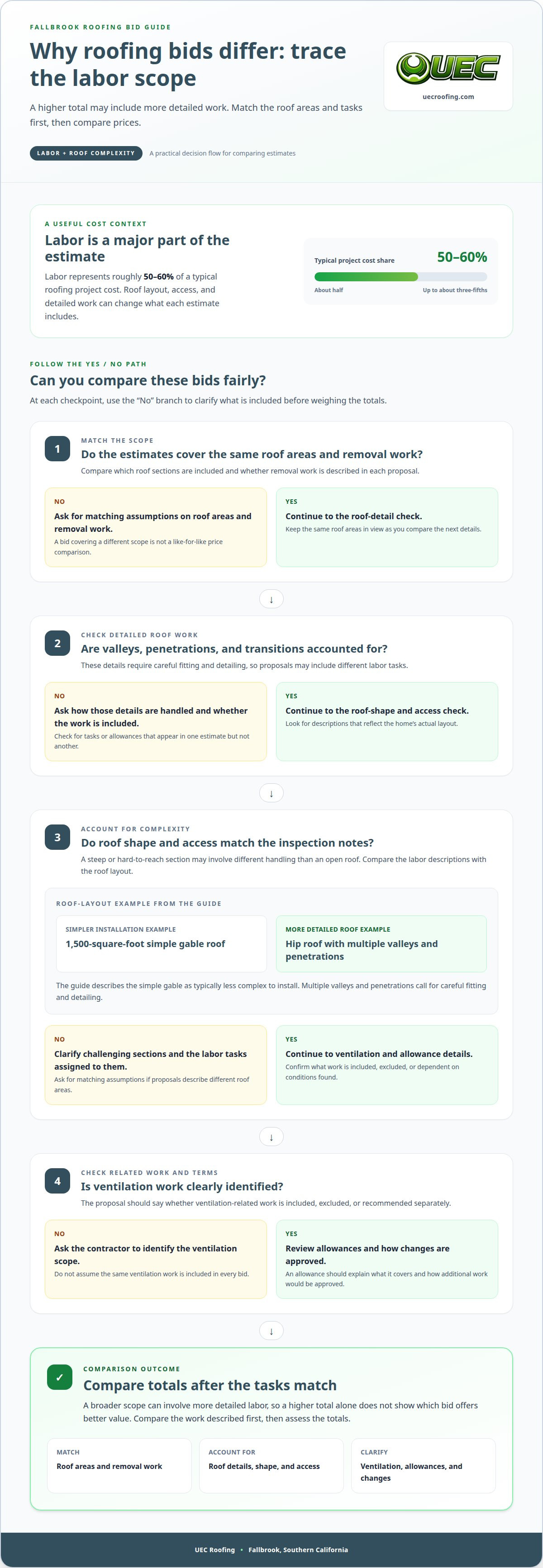
Labor represents roughly 50-60% of a typical roofing project cost. That share helps explain why bids can differ, even when Fallbrook homeowners request the same material. Roof shape, access, and detailed work affect the labor each contractor includes, so compare each estimate’s tasks before weighing its total.
Roof access also affects the work involved. A steep or hard-to-reach section may need different handling than an open roof. Compare inspection notes with labor descriptions to see whether challenging sections are included. If proposals describe different roof areas, ask for matching assumptions before comparing totals.
Energy efficiency and attic ventilation also deserve attention in a roofing bid. Ask whether the inspection considered existing attic ventilation and whether the proposed work affects it. The proposal should identify any ventilation work included, excluded, or recommended separately. This gives Fallbrook homeowners a clearer picture of how roof work relates to the home’s energy performance without assuming every roof needs the same changes.
Use the same comparison method for each roofing company:
- Match the roof areas and removal work included in each estimate.
- Compare how each proposal accounts for valleys, penetrations, and transitions.
- Note labor tasks or site conditions described in one bid but absent from another.
- Check whether ventilation-related work is included or outside the proposed scope.
For example, one estimate might cover a main roof plane, while another includes work around several penetrations and valleys. The broader scope involves more detailed labor, so a higher total alone doesn’t show which bid offers better value. Compare the tasks first, then assess the totals.
Fallbrook homeowners should distinguish an allowance from a defined task. An allowance may leave the final work dependent on conditions found during the project. The estimate should explain what it covers and how additional work would be approved. Clear terms show which labor and ventilation tasks are included before work begins.
Ask the contractor to explain labor differences using the roof layout and inspection findings. A careful roofing project assessment can connect roof complexity, ventilation considerations, and the work described in an estimate.
3. Professional proposals and inspection documentation
A professional roofing proposal should let Fallbrook homeowners trace each recommended task to an inspection finding. Photos labeled by roof area make that connection easier. For example, a picture of a damaged section should correspond to the work described for that section, rather than appear without context.
Compare proposals using the same details. A clear document identifies the work scope, materials, labor, inspection observations, warranty terms, and exclusions. It should also explain how changes are handled if crews uncover different conditions after work begins. These details distinguish a complete proposal from a brief total with little explanation.
Useful inspection records link photos to specific roof areas and explain why the proposed work addresses the observed conditions. In Fallbrook, ask the contractor to identify the location in each image and the related task. This lets you compare assessments without assuming different recommendations cover identical work.
- Look for labeled photos tied to roof sections or observed conditions.
- Match each major work item to an inspection note or image.
- Check that material and labor costs appear in the written contract.
- Review warranty terms, exclusions, and the process for approving changes.
Weather can affect the timing and sequence of roofing work. The proposal should explain how the contractor plans to handle scheduling if weather interrupts the work plan. It should also clarify which tasks remain incomplete and how schedule changes will be communicated.
Ask for the contract and proposal in writing before work begins. They should identify the agreed scope, labor and material prices, payment terms, and cleanup responsibilities. If a proposal uses broad phrases such as “complete roof work,” request a clearer description of the included tasks. Specific language gives both parties a shared reference if questions arise.
How long should roofing bids remain valid, and what payment schedule is typical in California? The proposal should state its expiration date; a quote valid for only 48 hours can be a pressure tactic. Payment terms depend on the written agreement, but Fallbrook homeowners shouldn’t pay the full roofing job cost before completion.
Compare the change-order process before signing. The contract should explain how newly discovered work is described, priced, and approved, rather than leaving decisions to informal conversations. Keep revised documents with the original proposal. A written record helps you track the agreed scope and payment terms throughout the project.
4. Avoiding suspiciously low bids
A low total deserves a closer review, not automatic rejection. Fallbrook homeowners should compare the written scope and deposit request before deciding. A bid may cover less work, use different materials, or leave key tasks unclear. Identify what explains the difference before reaching a decision.
Place the estimates side by side and compare the same work categories. Check whether each includes the same roof areas, removal, materials, labor, permits, and cleanup. If one proposal leaves out a task included in another, ask for a revised version using matching assumptions. That makes the comparison more meaningful than judging totals alone.
Look for gaps that could affect the finished roofing project:
- Materials are described broadly, without identifying the selected type.
- Removal, preparation, or disposal appears absent from the work description.
- Inspection findings don’t explain why the proposed scope is smaller.
- Exclusions or allowances leave important work open to later decisions.
- Payment terms require a large deposit without clear progress milestones.
Fallbrook homeowners should be cautious if a roofing contractor pairs a low bid with a large deposit request. A deposit is a contract term, so review its amount, timing, and connection to the planned work. Ask what the payment covers and how later payments relate to progress. The written agreement should explain the terms plainly.
Don’t pay the full roofing job cost before the work is complete. Compare the payment schedule with the scope and the work stages described in the contract. If payment is due before a major task begins, ask the contractor to explain the schedule in writing. Keep the signed agreement and any revisions together.
A concrete example can reveal a mismatch in scope. If one estimate includes removal and cleanup while another describes installation only, the smaller total doesn’t represent the same job. Ask whether those tasks are excluded or simply described elsewhere. Then compare revised proposals using the same checklist.
Review how the contractor handles unexpected conditions, too. The contract should explain how added work is documented, priced, and approved before proceeding. A verbal assurance may not clarify which tasks or payments will change. Written change terms give Fallbrook homeowners a clear record if the roof’s condition differs from the initial inspection.
Ask the contractor to explain each major difference in the estimate. A direct answer should connect the scope, materials, deposit, and payment schedule to the proposed work. If explanations remain vague, pause before signing. A careful review helps you judge whether a low bid reflects a genuinely narrower scope or leaves important details unresolved.
5. Checking references
References add a practical view of how a roofing contractor handled completed work. Ask for examples from projects similar to yours, completed within the previous 12-24 months. A roof replacement reference may be more relevant to your decision than a small repair if your project involves replacing the roof.
Contact references directly and ask about specific parts of the project. Find out whether the completed work matched the agreed scope, how the contractor communicated, and how the crew handled questions or changes. A homeowner’s account can help you assess the working relationship, not just the finished roof.
Keep the conversation focused on details you can compare across references:
- What type of roofing work did the contractor complete?
- Did the work match the written proposal and agreed schedule?
- How were questions, changes, or unexpected conditions handled?
- Was the site left orderly after the project?
- Would the homeowner hire the contractor again for similar work?
For example, if a reference describes a tile project, ask whether the contractor explained the work and kept the homeowner informed. If your home has a different roof type, that reference can still tell you about communication, but seek another example closer to your project’s scope.
Listen for concrete examples rather than broad praise. A reference who describes how a change was communicated gives you more useful context than a general statement of satisfaction. If references mention similar strengths or concerns, note those patterns and consider them alongside the written bid.
References can’t replace a contract review. Compare homeowners’ accounts with the proposal’s scope, payment terms, and change-order process. If a reference mentions additional work, check whether the contractor explained and documented the change before proceeding. This helps you understand how the written process worked on an actual project.
Before work begins, check that the roofing contractor is licensed and insured. Keep those checks separate from references: a past customer’s positive experience doesn’t establish current license or insurance status. Confirm both before signing or allowing work to start, and keep the relevant project documents together.
Use reference feedback to resolve specific concerns, not to replace your own comparison. If a homeowner describes unclear communication, ask the contractor how updates and project changes are handled. A direct answer, alongside the written terms, gives you a clearer basis for deciding among bids.
Ready to discuss your roof’s condition and project scope? Talk through your roofing project and the work you’re considering.
UEC Roofing
UEC Roofing helps Fallbrook homeowners assess roof concerns and consider appropriate next steps through roofing services, roof repair, leak repair, and roof tune-ups. From its brick-and-mortar location in Lake Elsinore, the company has completed over 2,000 successful projects in the region.
Share the roof issue and the scope you’re considering with UEC Roofing. We handle leak repairs, roof tune-ups, and other roofing work, helping you clarify which solution fits your concern and your roof’s condition.
Contact UEC Roofing to discuss your roof and possible next steps.
Choose your next step
Taking time with getting multiple roofing bids in Fallbrook gives you a clearer basis for a decision. The next step is turning that decision into a plan that suits your home. Treat the selected proposal as the start of a working conversation, not simply a signature. Before work begins, make sure you understand what happens next, who will coordinate the project, and how updates will be shared. This helps keep expectations aligned as the roofing work moves forward.
Use any remaining questions to guide the discussion. A clear conversation about your home’s condition can help determine whether the plan addresses the concern that prompted your search. For Fallbrook homeowners, this thoughtful next step matters because the roof protects the home and supports its long-term value. Choose a path based on the information you have and your priorities, rather than rushing into a decision.
To discuss your roof and possible next steps, contact UEC Roofing. Move forward with a plan you understand and feel ready to pursue.
Frequently Asked Questions
Should I Obtain 3 Estimates for My Roof Claim?
Three estimates can help you understand whether assessments and proposed work differ. Some insurance companies and policies recommend 3 bids for a roofing claim, but your policy’s process matters too. Treat each estimate as a separate assessment, not just a competing total. If one contractor identifies damage or recommends work the others don’t mention, compare the inspection evidence and ask how that finding affects the proposed repair.
What are the down sides for getting multiple bids for my roofing claim?
Getting several bids takes time and can delay decisions; gathering them may take days or even weeks. Coordinating inspections can also mean repeated visits and proposals that describe different work, making quick comparisons harder. Set a consistent scope for each assessment and keep the written bids together. If an urgent leak is worsening, focus first on documenting the damage and addressing immediate protection, then compare longer-term repair plans.
How many roofing bids should homeowners get in Fallbrook, CA?
Fallbrook homeowners planning a roof replacement should get more than one or two bids to compare. For an insurance claim, some insurance companies and policies recommend 3 bids. These recommendations aren’t a substitute for reviewing your policy or claim instructions. The useful number of estimates is enough to compare assessments and scopes without letting the bid process delay a needed decision.
How can homeowners compare roofing bids apples to apples?
Give each contractor the same project information and compare proposals against the same roof areas and planned outcome. Note where estimates use different assumptions, such as whether a repair addresses one section or several. Ask each contractor to explain the difference in writing. A side-by-side worksheet with columns for scope, exclusions, materials, warranty terms, and payment milestones makes gaps easier to spot.
What are common warning signs of a lowball or fraudulent roofing estimate?
Warning signs include a large deposit request, vague work descriptions, and promises missing from the written agreement. Be cautious if a contractor pressures you to accept immediately or asks for full payment before completion. A much lower bid deserves a scope review: check whether it leaves out removal, disposal, or work around roof details. Ask for every proposed change and payment term in writing.
How can I check local roofing contractor reviews, references, and complaint history?
Look for references from similar projects completed in the previous 12-24 months, then ask those homeowners about communication, workmanship, and how problems were handled. Read reviews for project-specific detail and recurring themes, rather than relying on a single rating. You can also look for publicly available complaint records using the contractor’s business name and license information. Compare any concerns with the contractor’s written responses and project documents.